
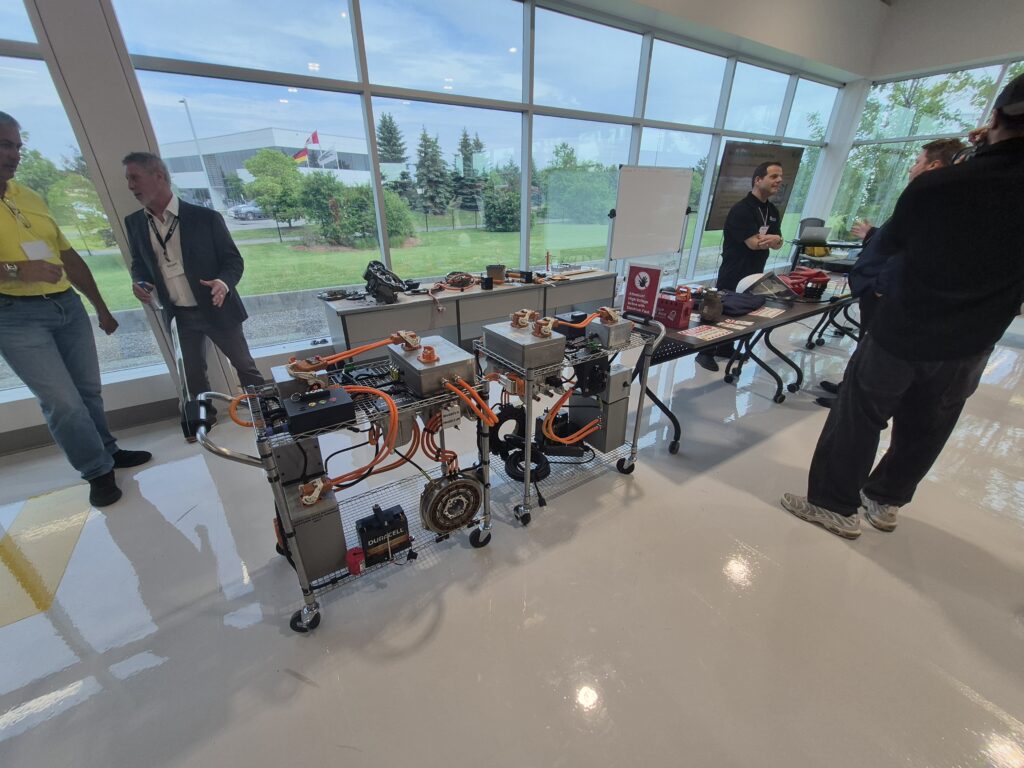
June 16, 2026 — The CWB Group and I-CAR Canada have launched a new electric vehicle training centre designed to help collision repair technicians develop the skills needed to safely repair and service the growing number of EVs entering Canadian repair facilities.
The announcement was made during a media event at the CWB Group’s Centre of Innovation in Milton, where industry leaders, government representatives, and collision repair stakeholders gathered to mark the facility’s opening and the launch of a five-day hands-on EV skills development course.
Trent Konrad, vice-president of business development and sales for CWB Group, said the organization is building on its long-standing expertise in training, certification, and workforce development to support the collision repair sector’s transition to electric vehicles.
“We’re hoping through CWB Group and our partnership with I-CAR Canada that we can take all those years and lessons learned and really build a strong foundation for a skilled workforce in the EV sector,” Konrad said.
The new training centre builds on a partnership established several years ago between CWB Group and industry stakeholders to deliver collision repair training across Canada. According to Konrad, the organization has trained and certified technicians nationwide through its Canadian Collision Repair Academy and related welding programs.
Scott Sinclair, business development manager for I-CAR Canada, said the initiative responds to the rapid growth of electric and hybrid vehicles and the increasing need for technicians to develop practical, hands-on experience working with high-voltage systems.
“Electric and hybrid vehicles are no longer something we are preparing for someday,” Sinclair said. “The risks are different, the systems are more complex, and the need for consistent repair readiness is growing.”
The five-day course was developed by I-CAR Canada and is delivered in partnership with CWB Group. The program focuses on EV safety, vehicle shutdown procedures, OEM repair requirements, and safe handling practices in a controlled training environment.
Sinclair said the goal is to establish a national baseline of competency for technicians working around electric vehicles.
“EV safety training is not just a program requirement,” he said. “It is a safety standard. It is a quality standard. And ultimately, it is a consumer confidence standard for the entire collision repair industry.”
The program is supported by industry partners, including Certified Collision Care, and is intended to align OEM expectations, equipment requirements, EV safety training, and certification standards across Canada.
Also speaking at the event was the Hon. Zee Hamid, MPP for Milton and Ontario’s associate solicitor general for auto theft and bail reform.
Hamid said Ontario is becoming a major centre for electric vehicle manufacturing and battery production, making investments in technician training increasingly important.
“Ontario is turning into an EV capital of North America,” Hamid said. “We’re attracting a lot of investment, not just in the manufacturing of EVs, but also on the battery side of things. Facilities like these are tremendously important.”
Hamid said the training centre will play a key role in preparing technicians for the changing vehicle landscape while supporting Ontario’s automotive sector.
The event also featured remarks from Stuart Klein, vice-president of collision programs and executive director of I-CAR Canada, who emphasized the importance of collaboration among training organizations, automakers, insurers, certification bodies, governments, and repair facilities to ensure the industry is prepared for the continued growth of electric vehicles.
“EV repair readiness requires more than written procedures or online awareness,” Klein said. “Technicians need practical, hands-on experience so they can recognize the risks, follow the right safety steps, and approach EV repairs with confidence before they are working on a customer vehicle.”
As part of the launch, CWB Group announced that prerequisite EV training modules will be offered free of charge until Sept. 1 to encourage industry participation and help accelerate EV repair readiness across Canada.