
New system combines A/C service, leak testing, and live vehicle diagnostics
September 1, 2026 — Autel U.S. has announced the availability of the MaxiHVAC AC909 Advanced A/C Diagnostic System, a comprehensive solution designed to help technicians diagnose, service, and verify increasingly complex automotive A/C and thermal management systems.
Autel U.S. is now accepting orders for the AC909D package, with shipments expected to begin by the end of September 2026.
For decades, automotive A/C service has focused largely on refrigerant recovery, recycling, and recharge, along with high- and low-side pressure readings. Refrigerant Recovery, Recycling, and Recharging Stations, commonly known as Triple-R equipment, remain necessary for proper refrigerant recovery and handling to meet U.S. Environmental Protection Agency requirements.
However, Triple-R equipment is not designed to provide a complete diagnostic picture.
Today’s HVAC and thermal management systems are increasingly complex, while traditional diagnostic approaches have remained relatively limited. Technicians need a way to understand what is happening throughout the system to determine why it is not operating correctly, including in situations with no trouble codes.
The stakes are also increasing.
Thermal management systems now do more than control cabin temperature. They are increasingly used to manage heat generated by high-performance vehicle systems, including batteries, power electronics, and high-wattage computer systems.
As these systems become more integrated with overall vehicle operation, the ability to diagnose thermal-management problems is becoming increasingly important.
The AC909 combines leak testing, refrigerant service, and live vehicle diagnostics in a guided workflow. Rather than relying on pressure readings alone, the system combines refrigerant data with vehicle diagnostics, airflow, temperature, electrical, and sensor information to help technicians understand system operation and identify potential root causes.
“We didn’t set out to build another A/C machine. We set out to give technicians a better way to understand and diagnose the entire HVAC system,” said Gary DeLuca, corporate strategist at Autel U.S., who spearheaded development of the AC909.
DeLuca said the industry’s diagnostic requirements have changed as vehicle technology has advanced.
“For too long, the industry has had a relatively limited answer to an increasingly complicated diagnostic problem,” he said. “The Triple-R machine is essential, but it was never intended to be a complete diagnostic solution.”
He said the growing integration of vehicle systems has made thermal management a more important part of vehicle operation.
“Vehicles are becoming extraordinarily complex,” DeLuca said. “We’re seeing dozens of modules consolidated into powerful centralized computers, ADAS systems with significant power and cooling demands, and EV and hybrid batteries that depend on sophisticated thermal management.”
“HVAC is no longer just about heating and cooling the cabin; these systems are increasingly responsible for cooling batteries, electronics, and the computers the vehicle needs.”
DeLuca said the technology will keep evolving, increasing the importance of diagnostic skills.
“If a thermal management system can’t properly cool those components, the vehicle will no longer operate, and the driver will be left stranded,” he said. “And this technology is only going to become more complex.”
“That’s why we developed the AC909 — to give technicians the information, tools, and diagnostic process they need to understand these systems today and build the knowledge they will need to diagnose the far more complex thermal management systems coming tomorrow.”
The AC909 brings live refrigerant pressures, temperatures, humidity, and other system measurements together on a graphical analysis screen, giving technicians a broader view of system operation.
Illustrated, step-by-step procedures help technicians isolate faults and verify repairs. Dedicated tests support diagnosis of compressors, evaporators, condensers, metering devices, and system blockages.
Real-world testing
Students at Pittsburg State University in Kansas participated in AC909 testing in May. The initial testing involved vehicles with properly functioning HVAC systems to establish normal operating conditions and determine whether the AC909 could identify them accurately.
Students then tested vehicles with poorly performing A/C systems to evaluate the system’s ability to identify problems.
“The AC909 diagnostic tool is like going from DOS to Windows,” said Scott Norman, professor and automotive technology program co-ordinator at Pittsburg State University, where he teaches mobile climate systems. “It is a huge game changer in the automotive industry.”
Norman, author of Auto Heating and Air Conditioning, said the system represents a significant advancement over conventional scan-tool diagnostics.
“It brings scan-tool diagnostics into the 21st century, as most scan tools are doing the same things they were doing 30 years ago,” he said.
Norman said bringing multiple sources of diagnostic information together can make the process more efficient.
“Bringing all this data into one screen in the AC909 is going to make A/C diagnostics faster and more efficient,” he said. “Technicians will be able to diagnose HVAC problems that they were only guessing at with older scan-tool methods.”
“The AC909 is developing new HVAC tests that will quickly identify problems that were almost impossible to solve with conventional methods. The AC909 is leading the way in the future of scan-tool diagnostics.”
Pittsburg State student Kael Rundquist, who participated in the testing, said the experience provided an opportunity to contribute to the development of the system.
“It was a once-in-a-lifetime opportunity to provide valuable input into the development of the cutting-edge AC909 scan tool,” Rundquist said.
Complete HVAC diagnostic and service system
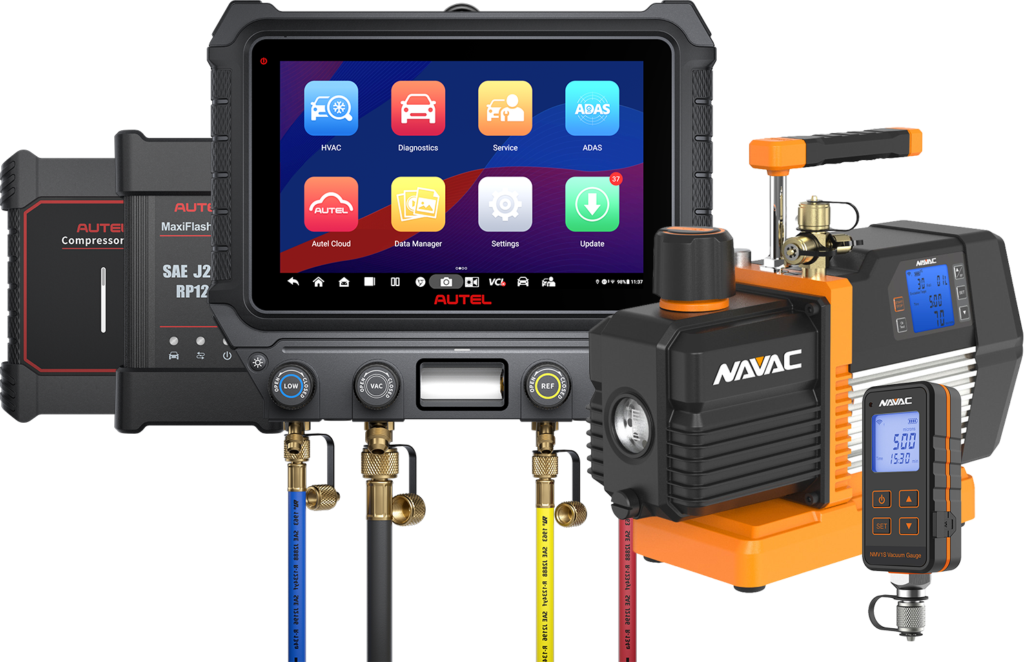
The AC909 platform combines equipment to measure, diagnose, service, and verify automotive HVAC systems.
The system includes the AC909 diagnostic tablet, MaxiFlash VCI, a four-port manifold with a large backlit sight glass, a compressor box, a refrigerant scale, Bluetooth temperature clamps, and Bluetooth temperature and humidity probes.
The AC909D package adds a NAVAC NP8DSV Bluetooth Smart Vacuum Pump and digital micron vacuum gauge. This combination brings commercial HVAC evacuation and verification practices into automotive service.
The AC909 tablet wirelessly controls the Bluetooth-enabled NAVAC vacuum pump and incorporates live vacuum measurements into the diagnostic and service workflow.
Precision micron measurement and decay testing allow technicians to verify moisture removal and system readiness rather than relying on evacuation time alone.
The package also includes a nitrogen regulator, refrigerant and vacuum hoses, fittings, R134a and R1234yf service couplings, and adapters.
Integrated nitrogen testing, precision micron measurement, and live system verification are intended to support the diagnostic and service process from initial testing through final repair verification.
Autel said it plans to expand the MaxiHVAC system with additional equipment and capabilities. Future upgrades are expected to include a purpose-built workstation and cabinet designed to organize the AC909 system and accommodate nitrogen and forming-gas cylinders used in advanced testing strategies.
Designed for electronically controlled A/C systems, hybrids, EVs, advanced heat pumps, and evolving refrigerant technologies, the AC909 supports the industry’s transition from conventional air conditioning to increasingly sophisticated vehicle thermal management.
The Autel MaxiHVAC AC909D Advanced A/C Diagnostic System is available to order through authorized Autel distributors, with shipments scheduled to begin by the end of September 2026.
For more information, visit autel.us/product/maxihvac-ac909/