
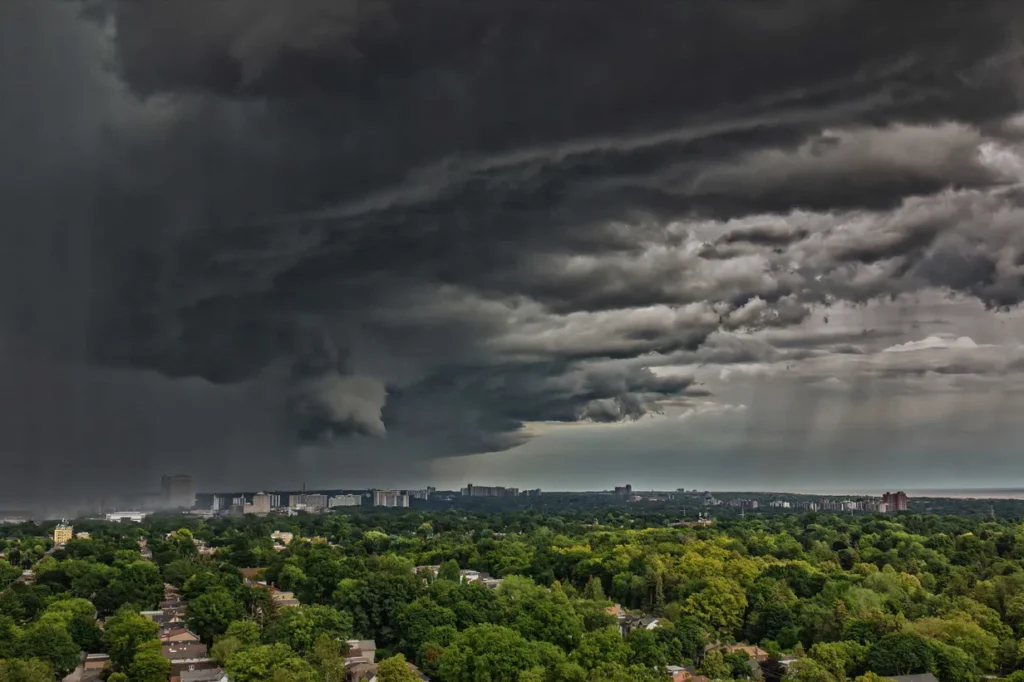
Four of Canada’s five costliest severe-weather summers have occurred in the past six years, according to the Insurance Bureau of Canada.
October 26, 2026 — Severe weather caused an estimated $3.7 billion in insured losses across Canada during summer 2026, making it the third-costliest summer on record, according to the Insurance Bureau of Canada (IBC) and Catastrophe Indices and Quantification Inc. (CatIQ).
The latest figures underscore the growing financial impact of extreme weather on Canadian households, businesses, and communities. Four of the five costliest summers for insured weather losses have occurred within the past six years.
Major events this summer included storms in Manitoba, Saskatchewan, and Montreal in June; storms across Ontario and Quebec in late June and early July; flooding in Ontario’s Niagara Region in July and August; wildfires in British Columbia; and additional flooding, wind, and hail events across the Prairies.
Costliest severe weather events of summer 2026
According to CatIQ estimates, insured losses from major weather events this summer included:
- Severe storms across the Prairies: $1.8 billion
- June storms in Manitoba, Saskatchewan, and Montreal: $1.1 billion
- British Columbia wildfires: $550 million
- Early-summer storms in Ontario and Quebec: $439 million
- July and August flooding in the Niagara Region: $360 million
“These events are part of a long-term pattern of increasingly severe and costly disasters across the country,” said Celyeste Power, president and CEO of IBC.
Extreme weather losses continue to climb
The $3.7-billion estimate places summer 2026 third among Canada’s costliest summers for insured extreme weather losses, behind 2024, when losses reached $8.8 billion, and 2013, when they totalled $3.9 billion. The figures are expressed in 2025 Canadian dollars.
Other costly summers include 2023, with $2.8 billion in insured losses, and 2020, with $1.7 billion.
Over the past decade, insured losses from extreme weather in Canada have averaged more than $3.7 billion annually. That compares with $1.4 billion annually in the previous decade and $883 million in the decade before that. According to IBC, annual losses have increased by roughly 300 per cent since the late 1990s and early 2000s, even after adjusting for inflation.
Canada recorded its costliest year for insured extreme weather losses in 2024, when the total exceeded $9 billion.
Rising costs affect households, businesses, governments, and communities, putting greater emphasis on reducing risk and improving the resilience of homes and infrastructure.
IBC calls for stronger protection against weather risks
IBC urges all levels of government to act to reduce Canada’s exposure to extreme weather. Its recommendations include:
- Strengthening land-use planning and restricting new residential development in high-risk flood and wildfire zones.
- Providing incentives for homeowners to adopt practical, affordable measures that reduce weather-related damage and recovery costs.
- Requiring cost-effective community-level mitigation, including flood-protection infrastructure and FireSmart measures, where development in high-risk areas cannot be avoided.
- Investing in resilient infrastructure to protect communities from flooding and other extreme weather.
- Strengthening building codes and construction standards to account for current and future climate risks.
- Providing homeowners, renters, and businesses with clear, accessible information to help them understand and reduce their exposure to severe weather.
“The insurance industry will continue to be there for Canadians following these devastating events. However, we cannot solve this issue on our own,” Power said. She added that IBC wants to work with governments to reduce risks to homes and businesses and invest in weather-resilient infrastructure.
The insured damage figures are estimates provided by CatIQ under licence to IBC.